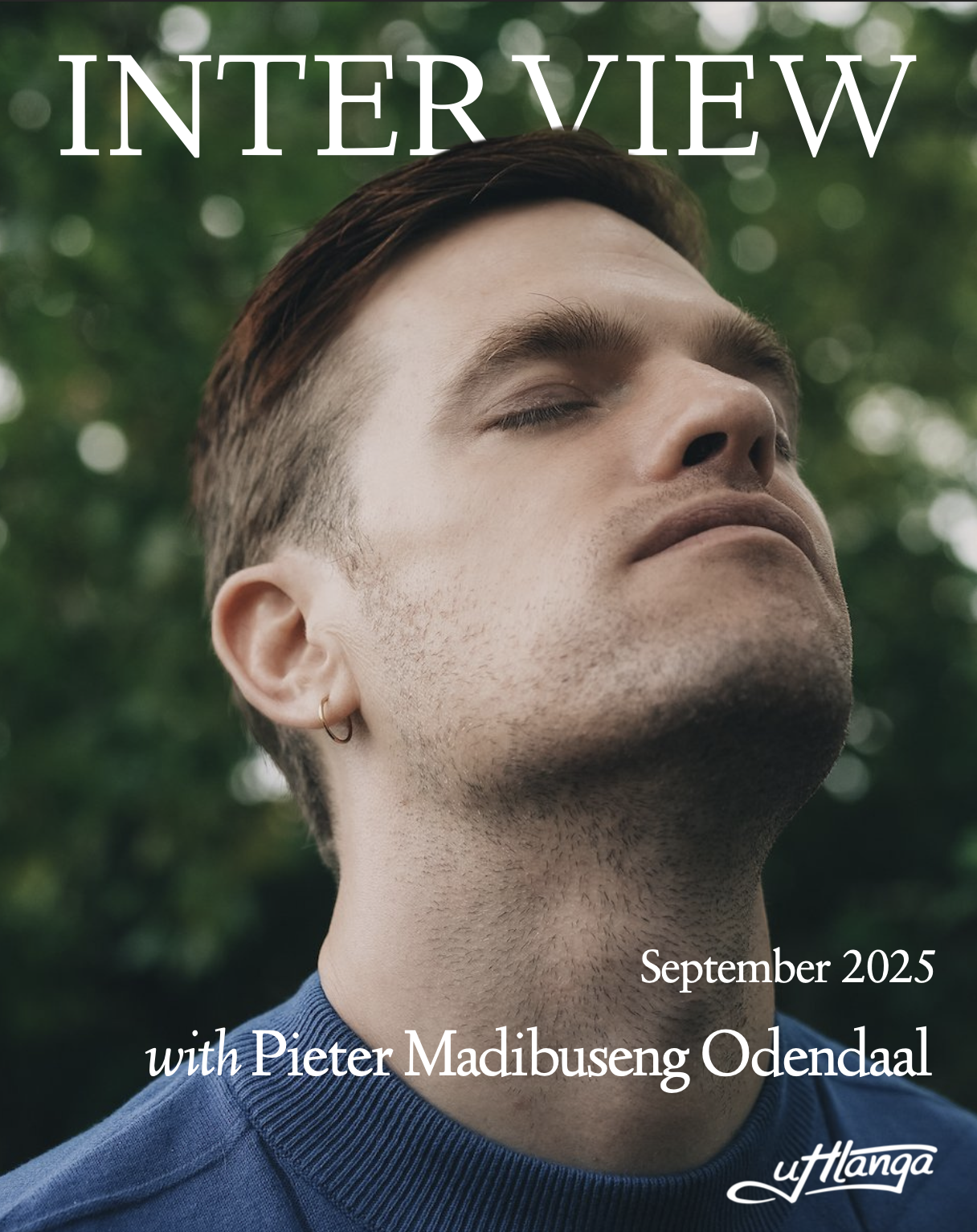
"Musicality is central to my poems": an interview with Pieter Madibuseng Odendaal

In the latest of a series of interviews with uHlanga poets, Megan Ross chats to Pieter Madibuseng Odendaal about his first collection in English, the questions raised by (self-)translation, and the influence of music on his award-winning poetry.


Congratulations on the publication of
a corpse is also a garden! The collection – your first in English, and which you translated yourself – is described as “self-deconstructed”.

I’m interested in translation – in the act of translation, but also, and in your case, the act of translating one’s own work. What was this process like, how did it feel?

The process of self-translation felt like a homecoming via a detour. Finding myself in another language helped me to rediscover the feelings and memories that inspired my poems in the first place, and the process became an interlinguistic meditation on what and why I write. Re-encountering my poems in English also exposed the weak spots in some and revealed the strengths in others, vindicating my poetry while enforcing humility.

Afrikaans is your first language. An onomatopeic language, at once alive and beautiful and strange, it is loaded with a fraught history. What was it like writing poetry that deals with your ancestors, and then translating that into a colonising language, a language like English?

I’ve mostly written in Afrikaans over the years, which has enabled me to confront the fraught history of the language head-on. By bending the language back on itself, I could hold up a mirror for Afrikaans-speaking people, one which hopefully allowed readers to question their own upbringing and the preconceptions and prejudices embedded in their language and culture. Excavating my family history, for instance, is something that could have only happened as brutally in Afrikaans. 

But I’ve always felt that my work resonated beyond an Afrikaans audience. Despite the contextual relevance of Afrikaans to my poetry, I’ve long harboured the desire to make my work accessible to more South Africans. These English translations make that larger conversation possible beyond the limitations of Afrikaans.

I’m always interested in this question when it comes to poetry, and new books, and publishing opportunities: why now? You’re an Ingrid Jonker prize-winning poet, critically acclaimed. What took you on this path (I detest the word “journey”) of writing a new collection? 

I finally had enough poems to pick and choose from in my first two collections that I could select what I consider to be my best work for an English readership. Now that I’m moving beyond some of the preoccupations of youth, it felt like the right time to also share this work in English.

I would be remiss if I didn’t bring up the title. The title! a corpse is also a garden. I’ve sat with it while creating social media content for uHlanga, while going about my day. Please, tell me about it. Its genesis, the melding together of such opposing concepts (in a way): the corpse, dead; the garden, generative, alive.

I was looking for a title that could capture the ambivalence that characterises my life and work – always the one and the other, opposites bleeding into each other. The title is an acknowledgement of the devastation of (and preoccupation with) death in my poetry, but also holds out hope for the generative consequences of mortality. Life does not stop with death, but simply continues in other forms. The energy stored in my cells and organs will not cease when I die, but will transform into flowers and fungi, sustaining those that are still living.

As an artist, you move between Afrikaans and English. How does writing in English shift your voice, your rhythms, or even your relationship to your audience?

Musicality is central to my poems – being a musician and having performed for most of my life, the way in which poems sound in my mouth and on stage has always been a principal consideration when deciding which turn of phrase, which word, to use. Transferring this musicality to English was one of the greatest joys of the translation process – finding another rhythm and sonority in English that could provide the scaffolding for what I wanted to say. 

I’ve always imagined an interlingual, intercultural audience, probably thanks to my days as director of InZync Poetry, promoting spoken word in the Western Cape. So I’m not sure if my relationship to my intended audience has fundamentally changed now that the poems are in English. But I’ve created a different kind of music to accompany them.

Tell us about the publication process: how have you found publishing with uHlanga?

The publication process was a breeze, probably because I had first sent my poems to Marike Beyers, a Makhanda poet and librarian, to edit and proofread, and to help with the order of the collection. Because the preparation was so extensive, once the manuscript arrived in Nick’s hands, there wasn’t much editing left. We took out a few poems and tweaked a line here or there, but the road from manuscript to book was surprisingly painless. Working with a smaller publisher also brought more of a personal touch to the whole process, a real sense that I was being looked after. This ethics of care seems to characterise uHlanga, and I count myself lucky to have found such a loving home for my poetry in English.
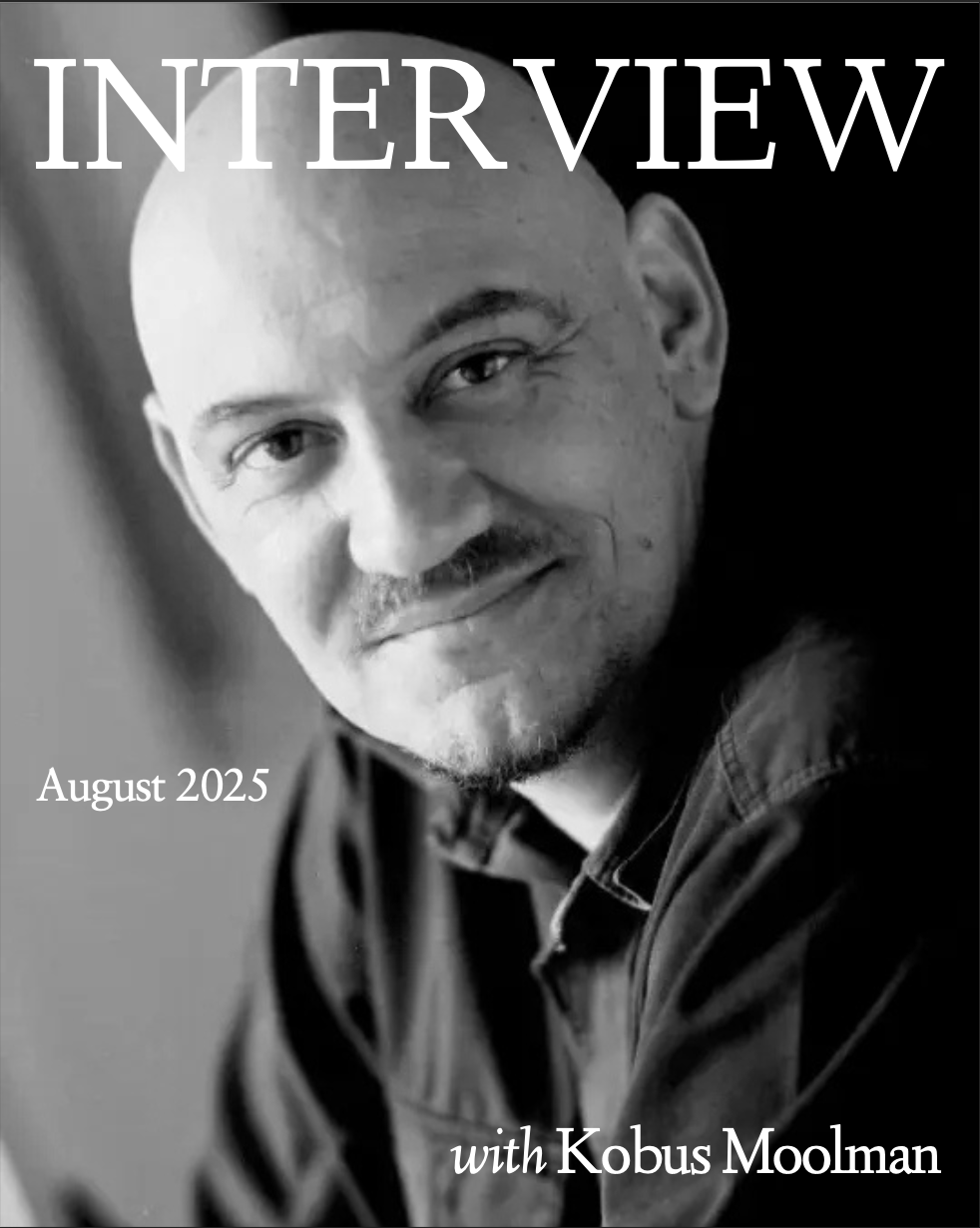
"It must be both": an interview with Kobus Moolman

Megan Ross chats to Professor Kobus Moolman about his latest collection, and the very deepest concerns of his long and distinguished career in writing and teaching poetry.


I recently reread Fall Risk, your latest poetry collection, published by uHlanga, and I was struck by these lines:

Skin is a machine
for feeling things

the way needles do.

This is at once an incredibly human image, and yet it also conjures up aspects of the clinical. Could you speak to this?

I think the clinical aspect that you so accurately identify has its origins in specific medical experiences [I have had], which reflect directly upon the collection as a whole. It is where the whole collection comes from in a way and speaks back to. This is both on a personal level historical, in the sense of being disabled since birth and having so many medical interventions over the years, and also recent, now, as someone who has to have monthly immunotherapy. So that’s the one side to the image. 

But as a writer the image must move beyond the purely personal. And thus while some poems in the book use the first-person singular – which of course, does not ever have to equate with the author – here there is in fact no speaker. On a certain level you could even say (and I like this idea) that the skin actually is the person or thing speaking, which then allows all skins – your skin, everyone’s skin – to speak.

There is an undercurrent of anguish in the collection, and yet the most overpowering feeling I am left with, upon each reading, is love. Always love. And I’ve felt that in many of your works. Could you tell us a little bit about love? Is it transformative? Damning? 

Oh dear. I really don’t know what to say about love. Such a fraught, dangerous, complicated terrain. But yet again, you are very accurate. I might for myself substitute the word ‘compassion’.  I am more comfortable using this word. 

In all my work – whether poetry or plays or short stories – I have always believed in having compassion for my characters, compassion for the world, compassion for others. I am moved deeply by suffering: human, animal, environmental. And so even when I am writing a horrible, ugly, violent piece – like the poem “the earth is flat” or my short story “Kiss and the Brigadier” (both of which are also very funny) – even then I have to have compassion for the terrible characters and events, and even compassion for the language, which might be twisted and cruel, but nevertheless has to be honest and real. As a writer I have to have compassion for reality.

In one poem in Fall Risk, you write about Anaïs Nin, the Sabbath, and God, and the number seven, and what it could all mean. I left this poem wondering about God and [their] love, or lover. I guess I just want to know, where did this poem ‘come from’? Was it a feeling, a question, a wondering?

And maybe, because I was brought up religious (Roman Catholic), I am interested, too, in the God of and in your poems. 

This is big – I honestly don’t know how to answer you. How to answer without actually just referring you back to everything I’ve ever written. How not to close my eyes and cover my eyes with my hands and just say nothing. Because nothing I say can summarise or describe my response to God – the idea of God, Gods, that, there, it, nothing, no-thing, light, dark, depth, infinite, mystery. Just the whole lot wrapped up into a tangle of stuff.  And hard to separate one’s past, growing up in a strict Calvinist background. NG church. And hard to separate those terrible ideas of guilt and punishment that cling to one still – despite all the scrubbing. But, in fact, the plain simple truth for me is that I do believe in something before and something after and something outside and something within all everything and suffused through all and beyond at the same time. And this whatever we call it – leave all the pronouns far behind –  this is the origin of every single small and big and beautiful and ugly thing I have ever written. That ultimately I am not the source. The source is the Dark Light.

In a recent interview with Quinton Mtyala on IOL, you said: 

“I've begun to understand the body and the relationship between the body and language, and different bodies using language differently, and how language can be used to show the body in its differentness.” 

I’d love to hear more about this, about the capacity of language to, as you say ‘activate’ something in someone, perhaps, in a way, give them a chance to convey the uniqueness of their humanity, or their experience of living in a body.

Again, this is the pursuit of Fall Risk, and most of my work over the last decade perhaps – an attempt to explore, to understand, and even to represent the multiple ways in which the body speaks. And I know that this term has become a little bit of a cliché. Kind of tossed around too easily. Without real in-depth and felt engagement. But for me it is felt. It is actually lived. It is a daily, lived-in experience. As it is for everyone in fact. But more often than not for many people the body is a triumph. A site of pleasure. Achievement. Strength. But what about those moments when it is not? When it is the opposite? What about a life lived in that other encounter? How to talk from or about this encounter? And the only way I have learned, and am still learning, struggling through, is to actually talk from this encounter. 

One of the most poignant lines, in my humble opinion, in Fall Risk is “I want to evaporate.” Is this a meditation on mortality, or the imperfectness of a human body, or is it more of a longing to just become a part of the natural fabric of the world?

It’s all of the above. And it’s also Keats’ idea, “to cease upon the midnight with no pain”. To be released.

[Long pause.] I think that’s enough of an answer.

You have published over ten collections of poetry. What is it about this medium that returns you to it, over and over?

I’m a sucker for punishment, I suppose. [Laughter.] But also because actually I haven’t said it. I’m not done yet. It’s still unfinished. I am still unfinished. I am still in search. Still looking for it. What’s that line from U2? “I still haven’t found what I’m looking for.” Plus, I am hungry. I am perpetually hungry.

I read that you teach your students to write a poem. And I love that. I don’t think I’ve ever been taught to write a poem… What has teaching poetry added to – or even taken away from – your experience of writing it yourself?

Phew! I love all your questions, Megan. But they are exhausting. Exhausting because they take me to the real deep centre, the challenges I struggle through on a daily basis. 

I love teaching. I really do. I love helping young people – students, whomever – understand something about themselves and their relationships to the world. Literature and art is one of the fundamental ways of doing this. And teaching the practice of making art for yourself – of making your own art – has helped me understand more keenly how I make my own art. 

But yes, if I have to be honest, honest with myself, then I know that it is taking a toll. It never used to. I was stronger. I was able to sustain, endure, live through the arduousness of the process. Arduous because each time I teach how to write I am going through and experiencing that “blank incapability of invention” that Mary Shelly described in her preface to Frankenstein. It is becoming increasingly difficult to keep doing so.

Much of your work is deeply rooted in the South African landscape, yet it often has an otherworldly or dreamlike quality. How do you balance the concrete and the surreal?

It must be both. That is what I strive for. One of the ways I have discovered how to do this is to be as plain and direct as possible to name the thing or things as they are. To force attention so that the reader sees or hears, smells, differently. Or smells the old tired thing in a new way. Shklovsky called it ‘defamiliarization’. That’s exactly it. Rendering the real with sharp and stripped, concentrated focus – through the language of poetry – weirdly, magically, releases or activates this ‘dreamlike quality’ that you speak of.

And finally, I’d love to chat a little bit about publishing with uHlanga. What was this process like, and what drew you to publishing with an indie press?

I’m not intending to flatter you or Nick in any way. But I have profoundly respected the collections that uHlanga has published. I’ve respected Nick’s enduring and passionate commitment to South African writing, specifically poetry. And I’ve wanted to be part of this. Indie presses are where the real fun is to be had, certainly with regards to poetry.  Look at presses like Deep South, Dye Hard, Karavan and Modjaji – they are publishing real stuff! And Nick has just been an absolute pleasure to work with. He hasn’t paid me to say this! [Laughter]

"Return to the beginning": Megan Ross interviews Sihle Ntuli about Owele

In our latest monthly interview with an uHlanga poet, Megan Ross finds out more about the genesis and revelations of Sihle Ntuli’s third collection, Owele.

Congratulations on the launch of Owele! I can't wait to read it. Could you talk a bit about this collection, and to what Daily Maverick describes as

"...a deeply personal return, not to a single place, but to a confluence of memory, language, and landscape"?

Much appreciated, Megan. Firstly, I will begin by giving thanks to God for all the abundant blessings. Before the collection begins, in the dedication I say ‘Kubo labo abasibonayo isidingo sokubhekana ngqo! nesimnyama sabo’. Here ‘isimnyama’ is referring to a number of things, all of which would require the kind of cleansing one would go to do at a river. I had been playing around in my mind with the idea of approaching a waterfall for the purpose of letting go. The poems I’ve written are in the pursuit of liberation. One of the revelations I had was to return to the beginning. 

This collection is, correct me if I'm wrong, written in both IsiZulu and English. Could you speak to what it has been like writing in both your mother tongue, and in, to quote two of the lines of your poem, a language that has done – and undone – so much?

“what is home if our neighbours only speak to me in English,
oblivious to what the language has done?”

The isiZulu spoken in KwaMashu is not the same as what is spoken in Ulundi or Nkandla. As you go further away from the urban into the rural, the isiZulu tends to become much ‘harder’. This is to say that those of us who live in the urban areas take many liberties with our language, whereas rural isiZulu retains the traditional – not only the cultural but also the linguistic. The experience of writing Owele came with many realisations about this. I was confronted by a lot of discomfort.  

Writing in isiZulu was difficult, I would not be here if not for the invaluable input of Sandile Ngidi and Musawenkosi Cabe. Beyond layers and layers of being colonised, institutionalised, etc., there was also this issue of the overbearing presence of English. It was the suggestion of the uHlanga director and editor of Owele, Nick Mulgrew, that some poems be written in isiZulu as a way to center Isintu, and an assertion of the need to re-indigenise. 

You've paired the poems with photographs from Samora Chapman, deeply moving landscapes that capture both the violence and beauty of waters. These are 'home' waters to you. How do they feature in the collection, and could you speak a bit to what it was like to have a visual element to this collection as well? 

Since the rivers in the collection are a connecting thread throughout, Nick thought it would be a good idea to include photographs in the collection. I had previously been opposed to visuals in past collections, but much of this collection has been about trying new things and I was open to the prospect of having a visual element to my work for the first time to heighten the experience. The visuals are an accompaniment to the river poems and provide a tranquil, calming element especially when holding the book in hand.

Photo by Samora Chapman

You're a classicist and a poet. I would be so interested to know how these things work in tandem with each other, especially when you're in the process of writing poetry, and how being a classicist, perhaps, influenced the poems in Owele?

Without disavowing the classics completely, I’d warn readers of my work to not make too much of this. I studied the Classics, got my MA at Rhodes and I’m very grateful for this, but the process of my writing poetry has very little to do with the Classics. With the traditional understanding of ancient civilizations being a study of Greece and Rome, I would put it plainly that there is none of that in Owele – but there are ancient civilizations present in the pan-African and Zulu contexts. One of my mentors at Rhodes, Mr Mike Lambert, was one of the most impressive classicists I had ever come across; he understood the need for the Classics to be adaptable to its geographical context. So if the Classics are indeed present then they are there organically. 

Is this collection in any way a departure from the poems you wrote in previous collections and chapbooks? 

I believe in craft insofar as working towards the mastery of it. I understand the importance of each chapbook and collection I have written, and how they have each contributed to my journey. So to say ‘departure’ would be to premeditate that Owele would be on a road of its own; while this may indeed be the case, it's still very much part of the same legacy. With Owele I was writing poems that I wanted to write for many years, including poems I was writing concurrently with the ones in Rumblin’, The Nation and Zabalaza Republic. Owele is significant in that all of the work I had been refining is finally coming out; while it looks like it took me two years between my previous book and this one, Owele took me a lot longer to figure out.  

Where does Owele 'fit in', so to speak, with your previous work, and do you feel that this publication process with uHlanga has been any different to previous experiences?

After Rumblin’ went out of print Nick was open to me pitching Owele to him; the publication of this book was earned through vigorous writing, revisions and rewriting. My only concern was that Owele should be a body of work that lives and breathes, and so I’ve endeavored to put all my years of learning into what I feel will be a work that will make supporters of my work very proud.

I had a very difficult publication process with my most recent full-length collection – without going into too much detail, I will just say that it was tough. uHlanga provided a smoother process where I felt challenged to do my best but was still respected enough to be heard. I’ve worked with Nick previously on the very first uHlanga magazine Issue 1, alongside future stars like Genna Gardini, Thabo Jijana and Musawenkosi Khanyile, all of whom went on to have very successful publications with uHlanga. 

When you work closely with Nick and the uHlanga team you begin to understand why, in a short ten-year period, uHlanga has earned the loyalty and support of its readers. I am grateful for this association and those who will in some instances be reading my work for the first time.