Introducing our free guide to self-publishing poetry in South Africa

Need something to do this summer?

Earlier this year, we had a tsunami of submissions flood our inboxes, thanks to our open submissions period. We read a lot of good poetry, but the experience also made us a bit sad and anxious: there were so many excellent submissions that we had to say no to, simply because there was not enough space or time to fit them in our publications calendar.

In the rejection letter we sent to every unsuccessful writer, we asked a simple question: what resources do you need to help your poetic journey? Dozens of writers responded. The response that we received the most, by far, was a request for guidance on how to self-publish poetry.

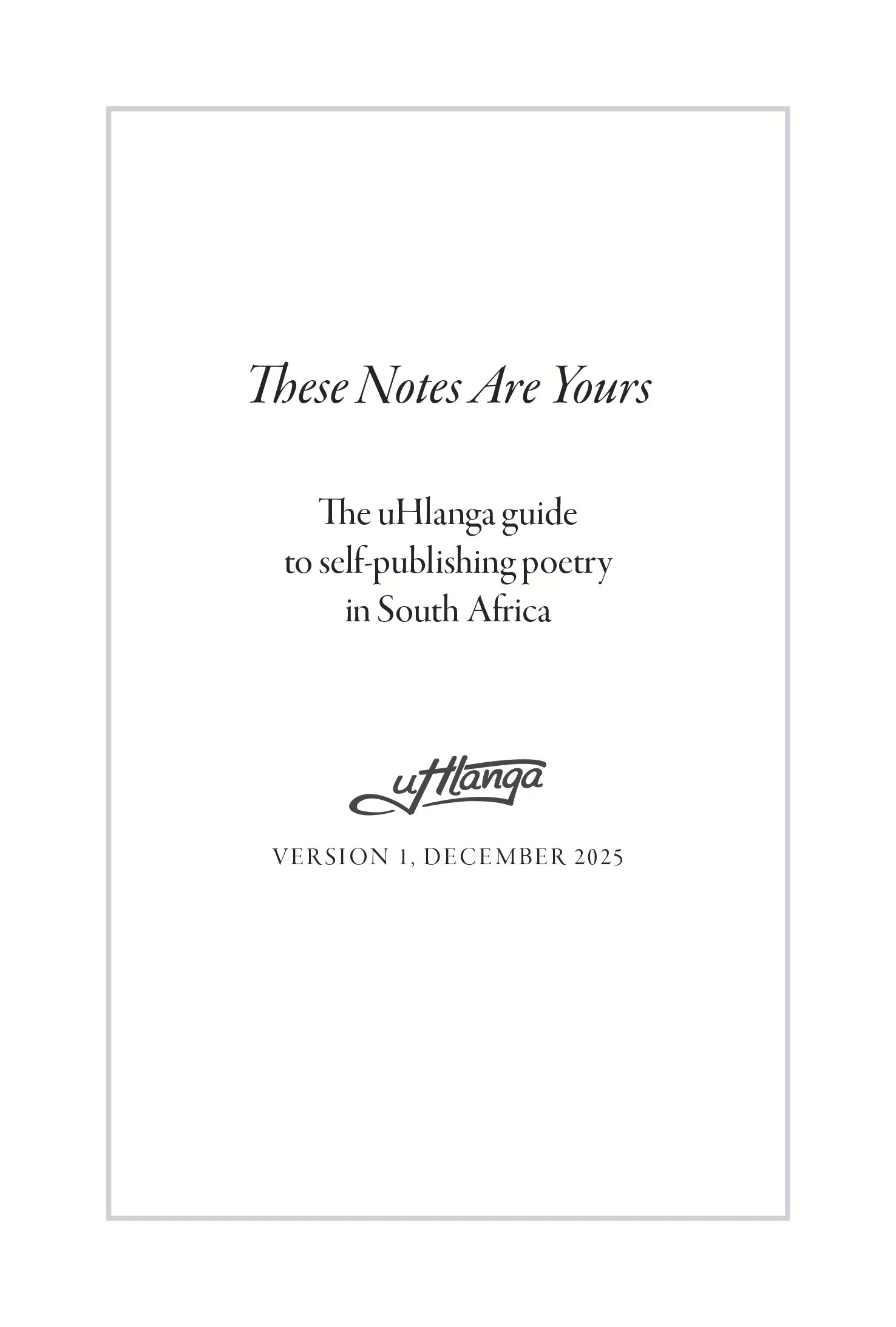
You spoke and we listened. Presenting: These Notes Are Yours, a free, 60-odd-page digital PDF document that is filled with notes, resources and contact details to help poets and other writers to self-publish their own poetry books, pamphlets and other publications in South Africa. (It also has plenty of advice for people outside of SA, too.)

Written by uHlanga founder Nick Mulgrew and uHlanga poet Megan Ross, and especially formatted for screens and phones, These Notes is a document filled with advice, helpful tips and trusted suppliers to help you take those steps yourself. This document focuses particularly on simple zines, but also offers advice and contacts to help you produce more commercial books, and who to contact to find potential sellers and distributors for your books.

Seeing as uHlanga cannot publish every book that deserves publication, we hope that, by offering a bit of advice, insight and connection, we can encourage more poets to become poet-publishers. And why not? Self-publishing is a bona fide poetic practice that includes many of the world's best-known poets, and has a long history in South Africa. Poetry is, in fact, one of the few kinds of writing in which self-publishing your work is a completely normal thing to do.

So if you're looking for a project to do this December, look no further. Did we mention that These Notes are free? It is licensed under Creative Commons, so you can even make These Notes into a book yourself, or use it as the basis of your own guide.

Head to the publication page to download These Notes, and share widely with your friends and poetry buddies. These Notes are intended to be a living document that we will update when appropriate; you will always find the most up-to-date version on our website. If you have additions or corrections – or are a supplier who wants to be listed in our supplier section – please mail notes@uhlangapress.co.za.

Events in Cape Town for November and December 2025

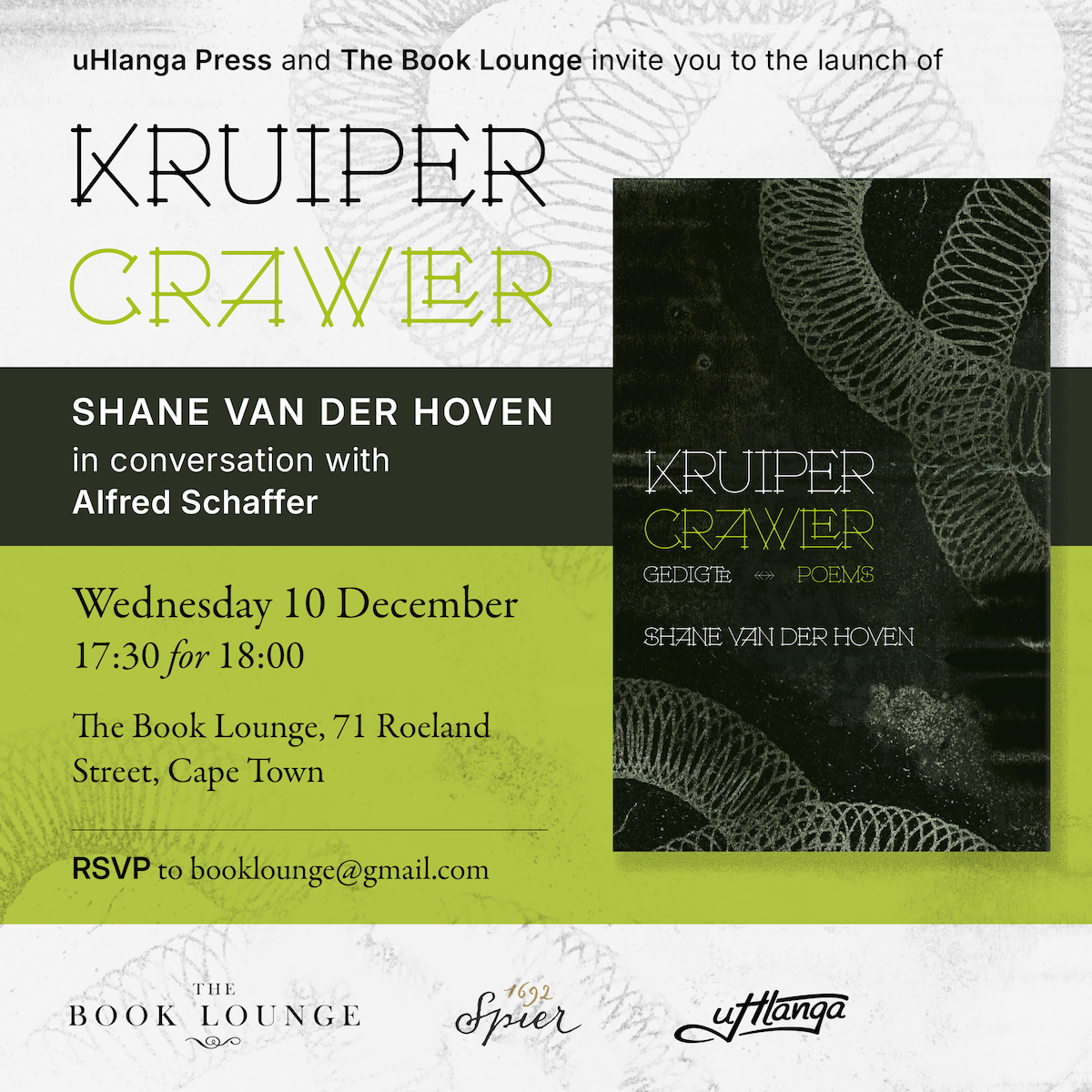
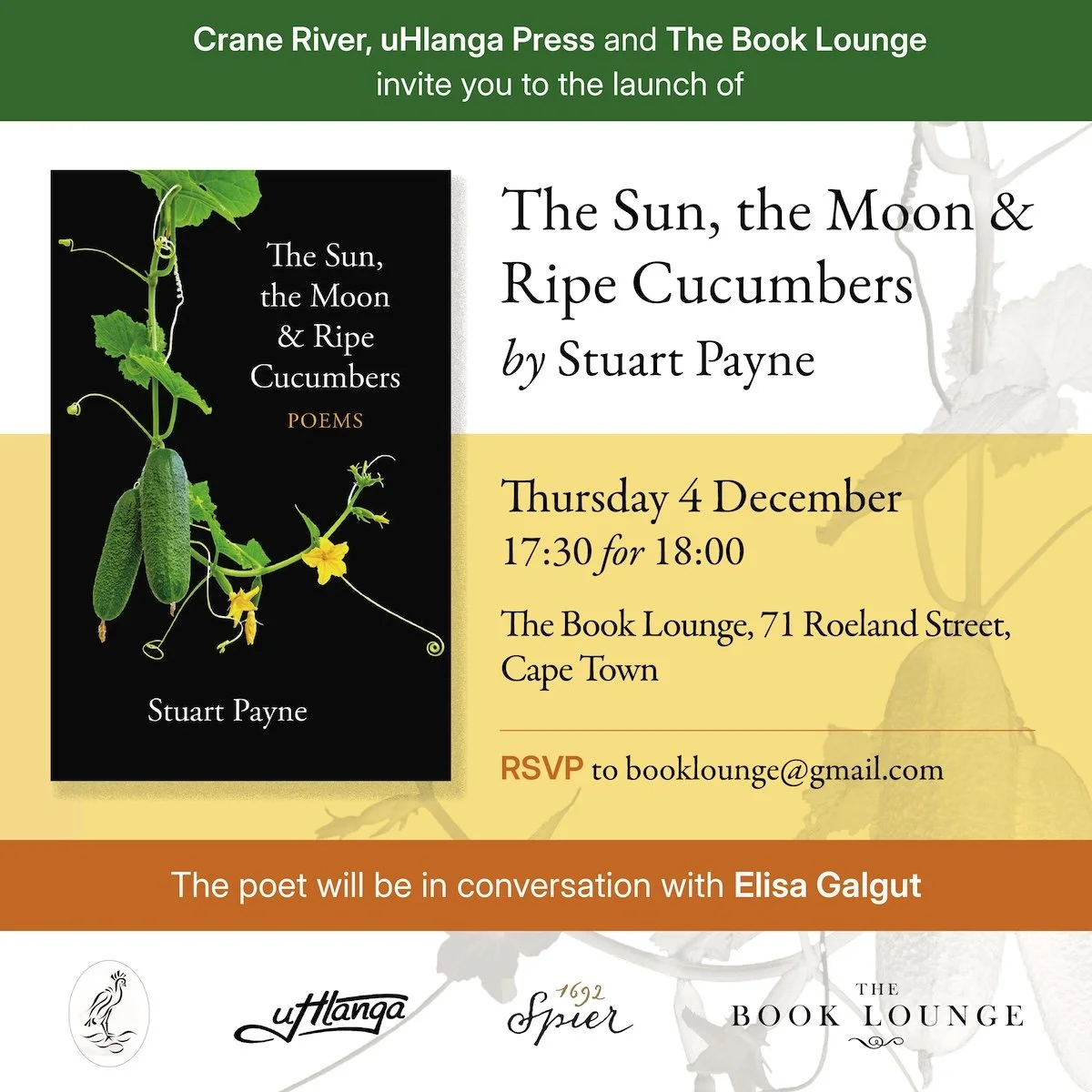
We are always grateful to our friends at The Book Lounge in Cape Town for hosting our launch events, and we are especially excited for their year-end events for three of our new releases – Owele by Sihle Ntuli, The Sun, the Moon & Ripe Cucumbers by Stuart Payne, and Kruiper-Crawler by Shane van der Hoven.

Tuesday 18 November 2025, 17:30 for 18:00
Book Lounge, CAPE TOWN
The poet will be in conversation with WAMUWI MBAO
RSVP to booklounge@gmail.com

Thursday 4 December 2025, 17:30 for 18:00
Book Lounge, CAPE TOWN
The poet will be in conversation with ELISA GALGUT
RSVP to booklounge@gmail.com

Wednesday 10 December 2025, 17:30 for 18:00
Book Lounge, CAPE TOWN
The poet will be in conversation with ALFRED SCHAFFER
RSVP to booklounge@gmail.com

See you there!

Move to Blue Weaver and Booksite

All of our trade customers are to note that uHlanga books will, from 1 October 2025, be represented by Blue Weaver and distributed by Booksite. We are looking forward to working with Blue Weaver’s professional and knowledgeable team.

Our books will soon be available to purchase directly from us online from Mzansi Books.

We would like to sincerely thank Phil, Nolu, Tamsin, and the rest of the warehouse team at Protea Distribution for their work with us since 2018, and wish them all the best for the future.

Announcing Kruiper-Crawler by Shane van der Hoven

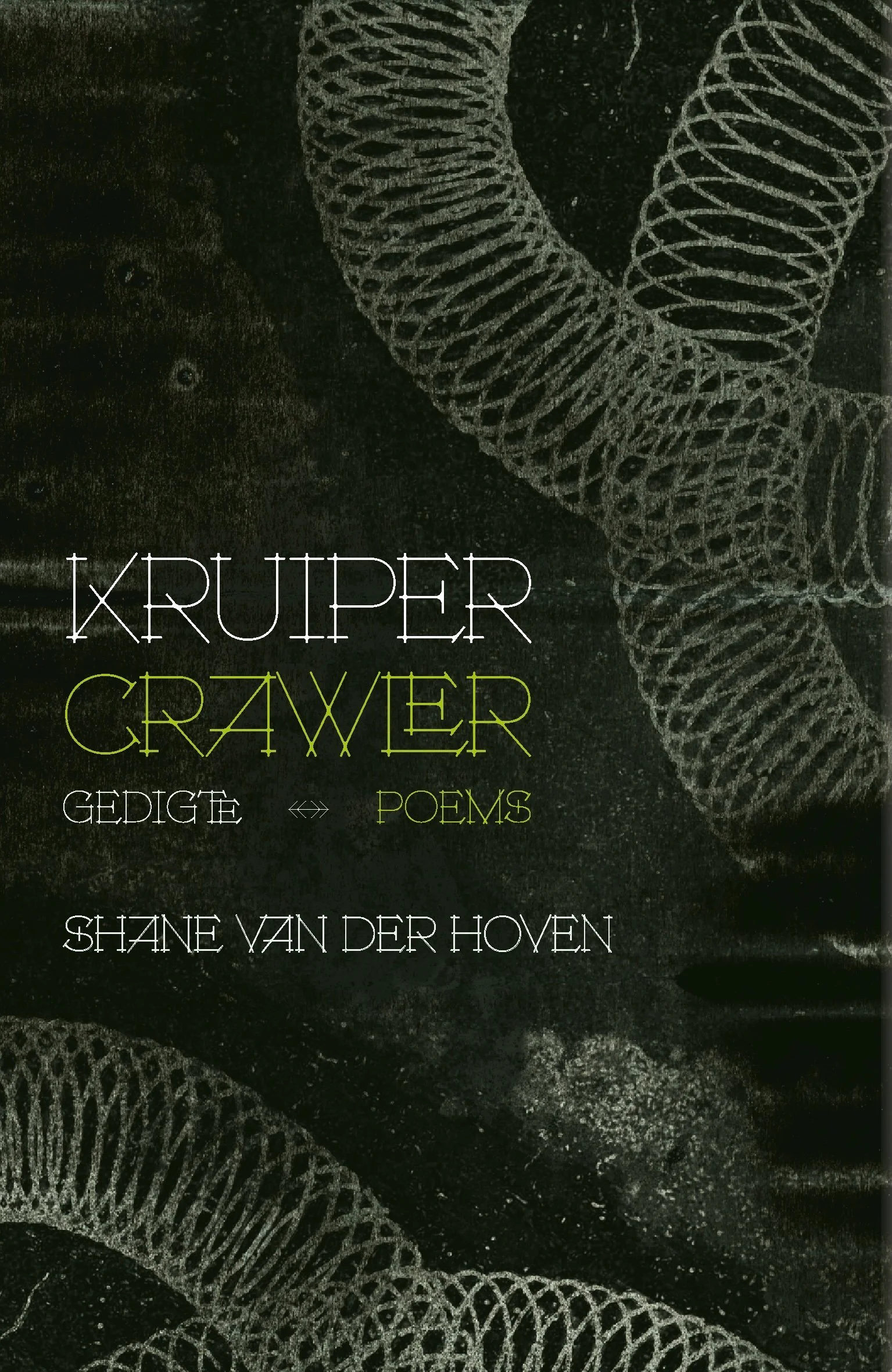
uHlanga is thrilled to announce the December 2025 publication of Kruiper-Crawler, the debut collection of poems by Shane van der Hoven, in a bilingual Afrikaans-English edition.

Kruiper-Crawler is a collection of poetry unlike any other – queer, radical, multi-segmented. It is also a completely new kind of book for uHlanga – Kruiper-Crawler’s thirty-something poems are presented both in Afrikaans and English, the translations differing, interfering with or even contradicting each other.

Kruiper-Crawler sees Shane van der Hoven explores both the sprawling lowveld and the decaying South African city through the metaphor of the Biblical crawler – the grotesque, misunderstood and unfairly maligned creatures of the earth and scrubland.

Infested with irony and literary allusion, Kruiper-Crawler’s exoskeleton may seem tough and spiny. But break through to its soft interior, and find yourself in a world of self-doubt and linguistic uncertainty, a deep love of the unknown, and, at its core, a young poet discovering what kind of creature they might be.

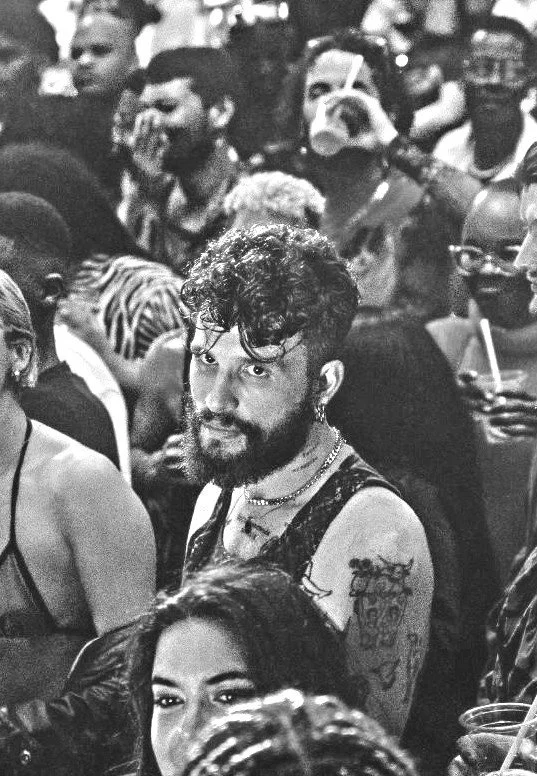
Shane van der Hoven was born in Benoni, raised in the Lowveld, and currently lives in Cape Town. They are a writer, lecturer, translator and editor. Kruiper-Crawler is their debut poetry collection.

Kruiper-Crawler releases on Monday 1 December 2025 in South Africa. Please see the book’s page for more information, en vir meer inligting in Afrikaans.

Review and press copies may be requested from nick@uhlangapress.co.za.

Please note, from October 2025, uHlanga is distributed by Booksite and represented to the trade by Blue Weaver.

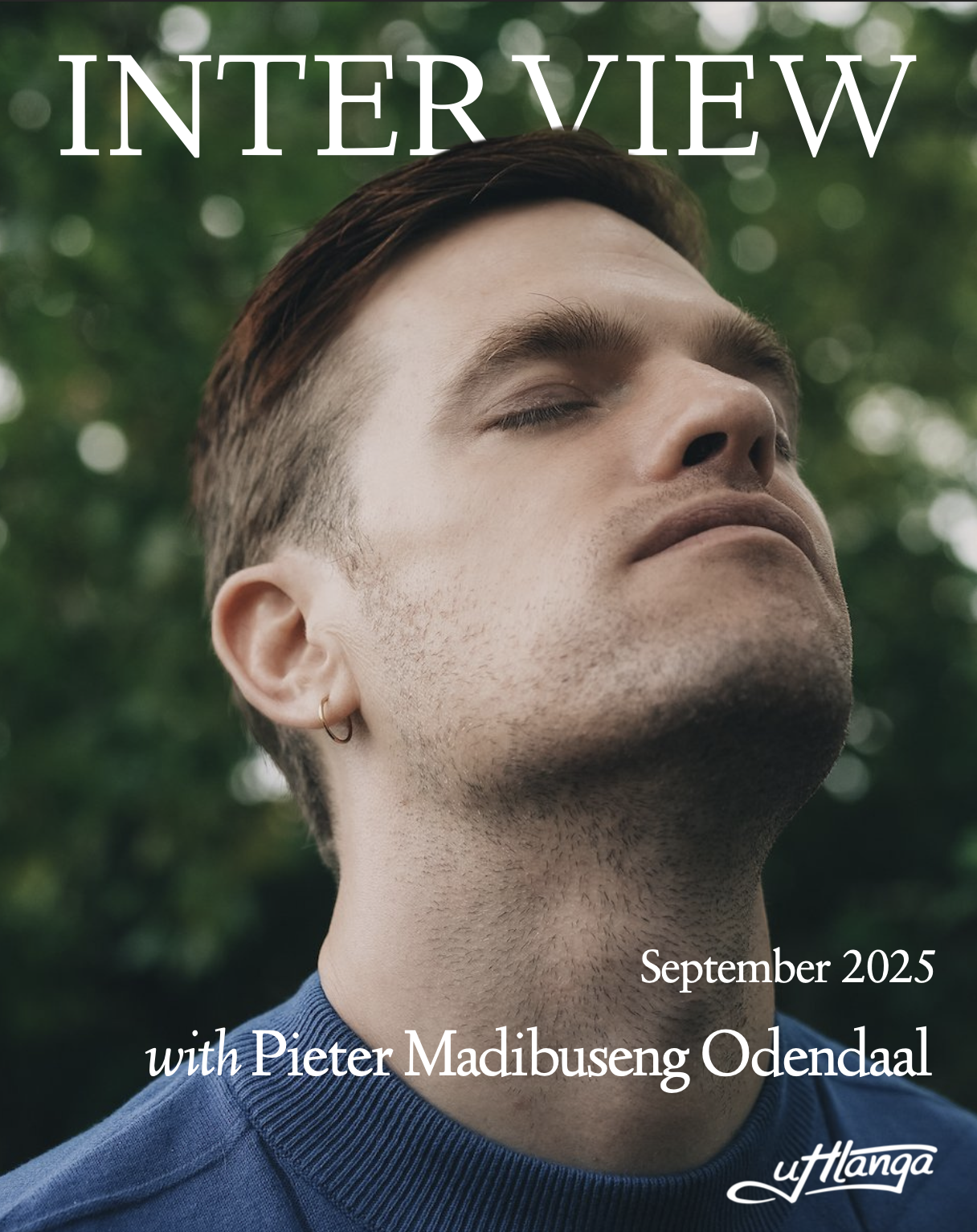
"Musicality is central to my poems": an interview with Pieter Madibuseng Odendaal

In the latest of a series of interviews with uHlanga poets, Megan Ross chats to Pieter Madibuseng Odendaal about his first collection in English, the questions raised by (self-)translation, and the influence of music on his award-winning poetry.


Congratulations on the publication of
a corpse is also a garden! The collection – your first in English, and which you translated yourself – is described as “self-deconstructed”.

I’m interested in translation – in the act of translation, but also, and in your case, the act of translating one’s own work. What was this process like, how did it feel?

The process of self-translation felt like a homecoming via a detour. Finding myself in another language helped me to rediscover the feelings and memories that inspired my poems in the first place, and the process became an interlinguistic meditation on what and why I write. Re-encountering my poems in English also exposed the weak spots in some and revealed the strengths in others, vindicating my poetry while enforcing humility.

Afrikaans is your first language. An onomatopeic language, at once alive and beautiful and strange, it is loaded with a fraught history. What was it like writing poetry that deals with your ancestors, and then translating that into a colonising language, a language like English?

I’ve mostly written in Afrikaans over the years, which has enabled me to confront the fraught history of the language head-on. By bending the language back on itself, I could hold up a mirror for Afrikaans-speaking people, one which hopefully allowed readers to question their own upbringing and the preconceptions and prejudices embedded in their language and culture. Excavating my family history, for instance, is something that could have only happened as brutally in Afrikaans. 

But I’ve always felt that my work resonated beyond an Afrikaans audience. Despite the contextual relevance of Afrikaans to my poetry, I’ve long harboured the desire to make my work accessible to more South Africans. These English translations make that larger conversation possible beyond the limitations of Afrikaans.

I’m always interested in this question when it comes to poetry, and new books, and publishing opportunities: why now? You’re an Ingrid Jonker prize-winning poet, critically acclaimed. What took you on this path (I detest the word “journey”) of writing a new collection? 

I finally had enough poems to pick and choose from in my first two collections that I could select what I consider to be my best work for an English readership. Now that I’m moving beyond some of the preoccupations of youth, it felt like the right time to also share this work in English.

I would be remiss if I didn’t bring up the title. The title! a corpse is also a garden. I’ve sat with it while creating social media content for uHlanga, while going about my day. Please, tell me about it. Its genesis, the melding together of such opposing concepts (in a way): the corpse, dead; the garden, generative, alive.

I was looking for a title that could capture the ambivalence that characterises my life and work – always the one and the other, opposites bleeding into each other. The title is an acknowledgement of the devastation of (and preoccupation with) death in my poetry, but also holds out hope for the generative consequences of mortality. Life does not stop with death, but simply continues in other forms. The energy stored in my cells and organs will not cease when I die, but will transform into flowers and fungi, sustaining those that are still living.

As an artist, you move between Afrikaans and English. How does writing in English shift your voice, your rhythms, or even your relationship to your audience?

Musicality is central to my poems – being a musician and having performed for most of my life, the way in which poems sound in my mouth and on stage has always been a principal consideration when deciding which turn of phrase, which word, to use. Transferring this musicality to English was one of the greatest joys of the translation process – finding another rhythm and sonority in English that could provide the scaffolding for what I wanted to say. 

I’ve always imagined an interlingual, intercultural audience, probably thanks to my days as director of InZync Poetry, promoting spoken word in the Western Cape. So I’m not sure if my relationship to my intended audience has fundamentally changed now that the poems are in English. But I’ve created a different kind of music to accompany them.

Tell us about the publication process: how have you found publishing with uHlanga?

The publication process was a breeze, probably because I had first sent my poems to Marike Beyers, a Makhanda poet and librarian, to edit and proofread, and to help with the order of the collection. Because the preparation was so extensive, once the manuscript arrived in Nick’s hands, there wasn’t much editing left. We took out a few poems and tweaked a line here or there, but the road from manuscript to book was surprisingly painless. Working with a smaller publisher also brought more of a personal touch to the whole process, a real sense that I was being looked after. This ethics of care seems to characterise uHlanga, and I count myself lucky to have found such a loving home for my poetry in English.