There is a phrase – “disobedient and uncontrollable body” – used to describe your new collection, Disabled, But. I like this; it speaks to refusal, and a rejection of narrative about women’s bodies. In this collection, how do you treat the body? And in your poems, do you reach any conclusions around whether the body can be known, or if it continuously resists this knowing, even by the self?
It sounds a lot simpler than what it is, but it also sounds more complex than it actually is. The poems in this collection get to know the feminine, disabled, and fractured body through various types of treatment. I would say that the collection shows the body being treated with disgust, nostalgia, longing, and even joy. The collection aims to show that, as the body changes and goes through pain, the way that we experience our bones wrapped in our flesh changes as well.
I would say that the body can be known, but only for a brief moment. Just as our minds long for peace, so do our bodies. When you live with a disability or impairment, you live in a state of knowing that your body is always pushing you away, just to find its moment of peace, with no pain.
The title Disabled carries weight and then there’s this but. Can we explore the “but”?
The “but” represents many things. For each poem it’s different, but the “but” represents what comes with a disability. It represents the deep breath that you get when you finally figure out how to do something as mundane as tie your shoelaces. The “but” is an invitation that tells readers “this collection will show you what comes after the disability diagnosis”.
This is your debut – congratulations! What are you hoping readers might take away from these poems?
Thank you so much! I hope I never grasp that this has happened to me. The longer these poems are out in the world, the more I understand that they are meant to change the readers, to make them more honest and to receive the honesty of others with an open mouth and chest, experiencing it in the body’s most vulnerable parts. I would really love readers to receive the poems with a blank page in mind – I want the poems to give readers an inch of an understanding of the experience of living with a disability. I’m hoping that this collection will be a stepping stone for the change that I would like to make in the disability sector. My dream is for readers to receive these poems and see the world in a new way – a way that shows the discomfort that individuals living with disabilities go through.
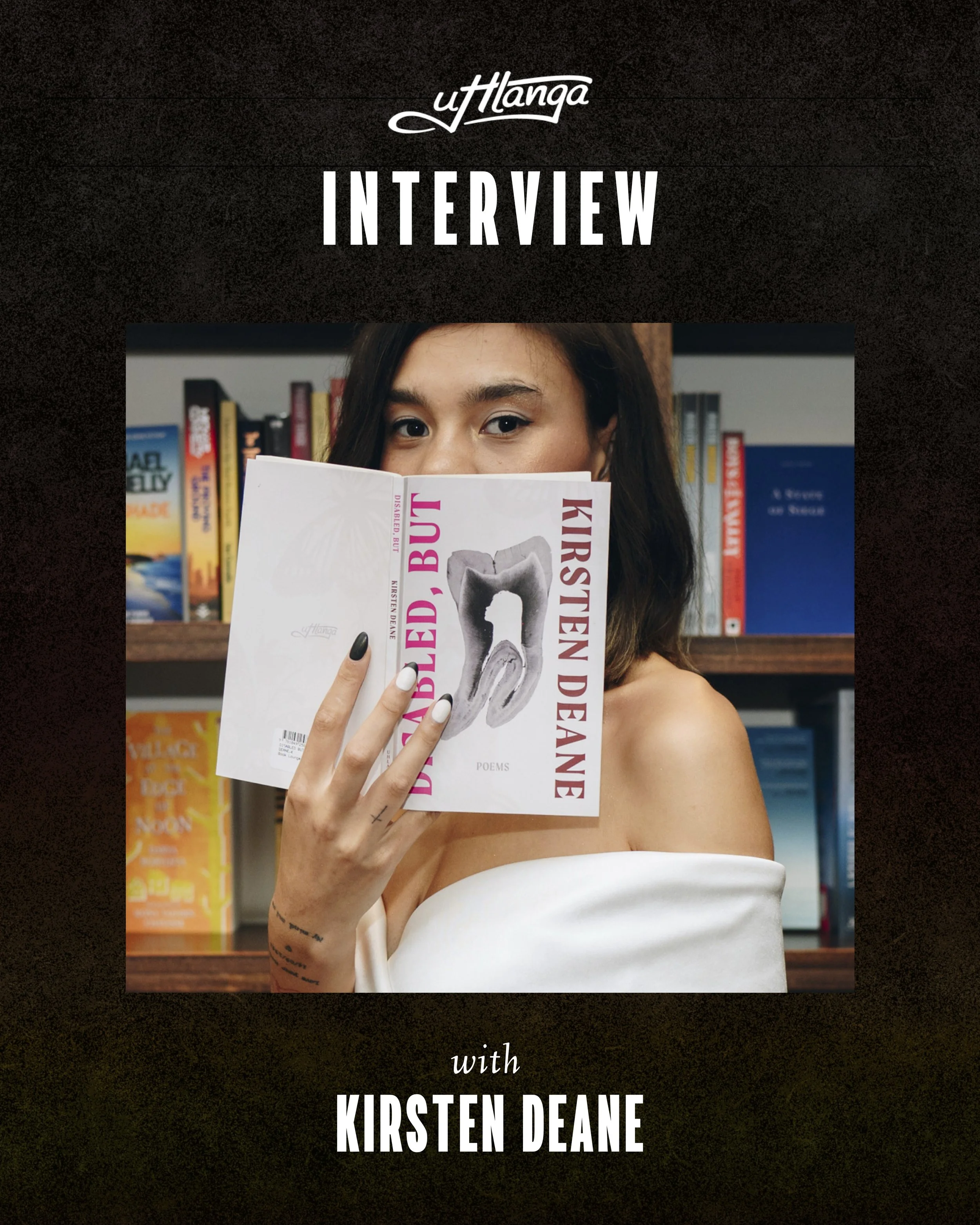
The cover of Disabled, But is a sort of pop-horror with the hot pink and the tooth. In the poem, ‘For the dogs’, you write:
“You left yourself here,
The dogs will feast tonight.”
That’s gnarly, gothic even! How do you hold these energies, in your poetry of course, but also perhaps in yourself too?
I find it difficult to separate myself from my poetry. I only understand the world through poetry, I only know how to function through poetry, really. Growing up, I always had this dream of being a princess or fairy or anything that felt feminine and gentle to me. I wanted to feel pretty because my disability had always made me feel disgusting. This was, of course, prompted by the bullying that I went through. So the softness, I would say, definitely comes from my inner child. She is gentle, happy, kind, friendly, creative.
I love body horror. It feels real because it is real. One of my (life) goals is to experience and understand as many uncomfortable and disgusting moments as possible. I want to understand the things and moments that so often make us want to crawl into our skin and hide under the covers. A massive part of me wants to set the flesh alight and pull the covers off – I want to face the disgust.
I’m able to have a love for both of these energies and hold space for each because I have never believed in only being one thing. I love change just as much as I love discomfort. I love knowing that my poetry can be pretty, but also infectious.
It is a vulnerable thing to publish a collection. I remember feeling like my skin had been flailed after I launched Milk Fever with uHlanga in 2018. While I felt particularly held by Nick, and through the publishing process, there was a definite feeling of being exposed almost… Is this familiar to you? Or has your experience been different?
100%. I always knew that the way I write is brutal and honest in a way that scares most people. My sensation of vulnerability came from knowing that I was about to say something that people have been saying for centuries, but I was about to say it in a way that’s not – how can I put this – ladylike. It’s interesting because I find femininity to be an extremely interesting topic, but more than that, I find being feminine and fucking honest to be the most liberating and yet gentle sensation.
Your poems are both accessible and estranging. As a poet myself, I am so interested in what is shown and hidden, what is opaque or less opaque. And perhaps what motivates a writer to hold back in some places while letting go in others. How do you make those decisions?
I’m not sure, actually, but I love not knowing. There’s so many poems that I thought would belong in this collection, but as the body of it continued to grow, its intention and experience became clear. When I have a poem, I always ask myself, “Is this poem a newborn, or does it belong to an existing body?” The poems in this collection were chosen because they belong to the same community. They might not feel or express the same things, but they all exist in and through a specific core experience. For this collection, it’s my disability.
Who inspires you as an artist? Are they all poets, or are you informed by other genres too, and – on genre – which genres are you drawn to in particular?
Unpopular opinion, but I’m sure it’ll make sense for most of my readers – my favourite poet has always been Charles Bukowski. His honesty is what made me realise, “ooooh, writing is the place where you don’t need a filter.”
I’m extremely inspired by vulgarity and visual artists who express themselves completely. I absolutely love creative non-fiction and prose poetry. I’m currently working on translating my poems into creative non-fiction short stories so I’m especially enjoying short stories at the moment. I’m also drawn to children’s books. I love all things fairy tales and wonderland. I’ve recently been reading the book series A Twisted Tale by Elizabeth J. Braswell. The novels are based on my favourite childhood storybooks such as Alice’s Adventures In Wonderland, but are written in the 21st century for adults, so they’re right up my alley!
In terms of pronouns – the “I”, the “you” – how do you strike a balance between writing autobiographically in your poetry, with writing from other peoples’ perspectives, perhaps to other perspectives?
It’s really just about who the poem wants to talk to and from what perspective it wants to tell its story from. A reader will have a different sensation when they read the pronoun ‘they’ instead of ‘you’, even when they are reading about something that is clearly relatable for them. For me, it’s about what the poem wants to say, from what angle, and what side effects does it want the reader to be left with.
In ‘It Is Daylight’, Louise Glück writes:
“The soul is silent. If it speaks at all it speaks in dreams.”
As a spiritual person and a Christian believer – I’m thinking here of your Instagram handle, too – what role do your dreams play in your writing and creative life? Is there a relationship between your belief system and your artistic life?
I love when people ask me about my belief system after reading my poetry. I know that it’s difficult for people to look at me, speak to me, engage with me, and then read my poetry. Because I write about everyday things – even though readers might be caught off-guard by the poems – the reality is that the experiences that these poems explore are happening to individuals every second of every day.
My belief system definitely fuels my artistic life. I believe that I was created by the creator of all things. Knowing this reminds me that I was born out of creativity and therefore, to create. To write, to draw, to paint, to scrapbook, to put anything and everything together.